



A Deep Dive into Artificial Intelligence
This report was prepared by Frais Capital Research Analysts Lu Huang and Liam Nguyen and reviewed by industry experts. Lu has been studying the applications of machine learning in finance as part of her degree at the University of Melbourne.
Since ChatGPT launched in November 2022, AI has accounted for 75% of S&P 500 returns, 80% of earnings growth and 90% of capital spending growth. Going long in the S&P 500 Index is now equivalent to going long in the AI industry.
With so much ‘hype’ around AI, it is important to be able to separate truth from fantasy in the media. For investors, this means understanding how AI works, what it can be used for and what this might mean for markets.
In this special Frais Capital technology update, we delve into the good and the bad of AI and break down the massive investments taking place across the tech firms.
How They Work: Large Language Models
First let us define some terminology. Generative AI refers to any AI model that can create content – text, video or audio. Large Language Models (LLMs) are a specific type of generative AI that produces human-like text. Most of the popular models like ChatGPT and Gemini are large language models because they are primarily used to generate text.
Preparing the Training Data
Large Language Models (LLMs) are the basic building blocks for most generative AI that we use – ChatGPT, Claude, Gemini etc. Generally, LLMs take huge amounts of text from the internet and learn the statistical relationships within the text to develop language and reasoning. Overtime, LLMs have developed to become multi-modal – meaning they can process and integrate information from multiple types of data (not just text).
To keep it simple, we will focus on text interpretation and generation.
To train an LLM, language is first transformed into numbers. Thus, AI models are not in fact learning learn to read or write like we do but simply interpreting numbers that are associated to specific words.
As a simplified example, the word “dog” might become [1], the word “cat” might become [2] and the word “rabbit” might become [3]. OpenAI, Google, Meta all have their own individual methods to perform this translation whilst capturing as much meaning as possible within the numbers. They take huge amounts of data from the internet, translate it and use it to train their respective models.
This translation of language into numbers is one reason why AI is so energy demanding. One word is typically encoded with thousands of numbers. Think about all the possible use cases of the word ‘bark’ – a dog barks, bark on a tree and idioms like “all bark and no bite” – all of this needs to be captured into one set of numbers. This results in a huge dataset – which means we need a lot of processing power.
Learning
LLMs develop their “reasoning” capabilities using an algorithm called a neural network. A neural network is composed of multiple connected layers that relate an input to an output. We feed our translated text into the input layer, perform calculations in the hidden layers and return an output. When we talk about training an LLM, we are training the model to learn the best neural network based on the data it has.

The neural networks that form the foundations of mainstream generative AI models are built on a type of neural network called Transformer networks. It is essentially trying to replicate the neural pathways of our brains within a machine by mapping the relationships of different texts. Its output is a set of probabilities that allows the model to probabilistically predict what the next word they output should be. The key difference is that while our brains create new neural pathways through learning, the model never learns new connections beyond what it learns from its training data.
This is why, in the early days of generative AI, the models tended to falsely report who the president of the United States was.
Overtime models have developed by improving the quality of training data (not just the internet) alongside specialized refining techniques that train the models in a skill area or update the model with the latest information. While AI cannot solve Nobel prize winning math problems yet, it can at least take the derivative of a function.
We underscore that current AI does not think or learn like we do, it is only as good as the data and refining techniques it is trained on. Its responses are a function of complex mathematical transformations it learns in training.
Generating false information is not an error but rather a feature of how it is designed – probabilistic text generation through neural networks.
AI “Circular” Investments
Introduction to circular investments
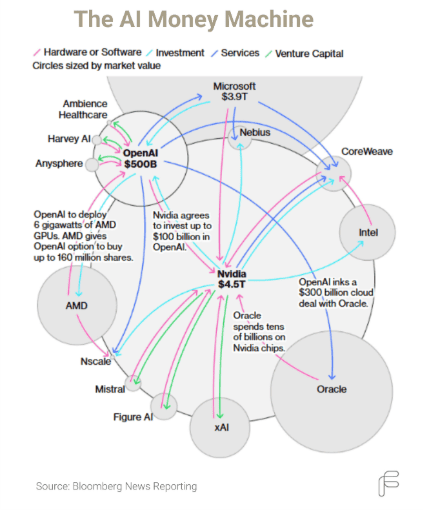
A series of large deals between key AI companies have sparked concerns over “roundtripping” or circular financing amidst the AI boom. In simple terms, circular financing occurs when two companies are investing in each other, which can create artificial demand. For instance, a fruit company invests $1 million into a grocery store, which then uses that capital to buy fruit company products. Hence, reported revenues can be misleading and it is harder to decipher organic revenue growth from external sales compared to artificial growth from circular funding.
Key players and deals
The recent wave of unprecedented deals involving the main AI players (Nvidia, OpenAI, Oracle and AMD) has escalated concerns of an increasingly complex and interconnected web of transactions that is artificially propping up a “trillion-dollar” AI industry.
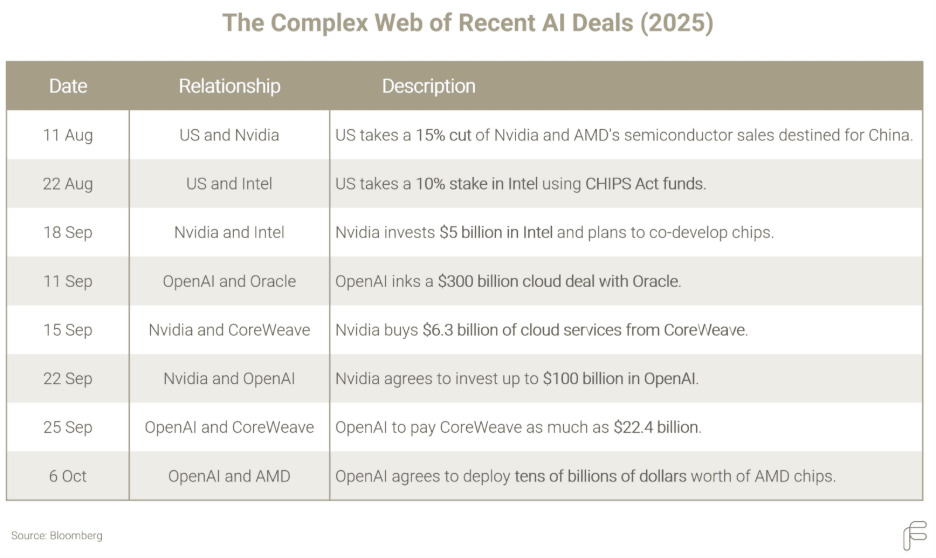
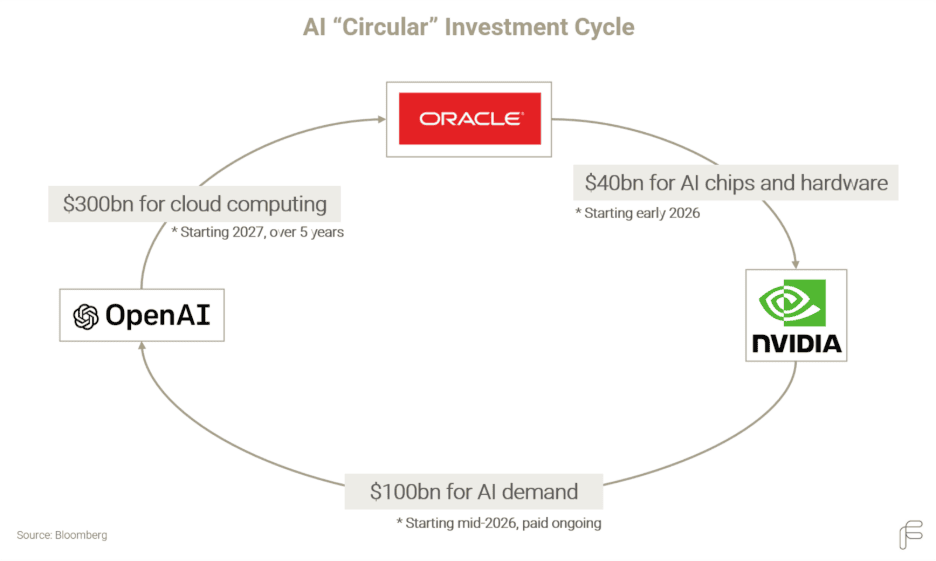
Shortly after OpenAI and Oracle confirmed a $300bn deal to build data centers in the US, OpenAI confirmed a separate $100bn partnership with Nvidia to use its GPUs. Simply, OpenAI’s money flows to Oracle, Oracle’s money goes to NVIDIA, and NVIDIA’s money flows back into OpenAI – hence the circular funding concern.
What the Critics Say
Concerned investors are vigilant about a potential bubble similar to the late-1990’s dot-com boom. Such interconnected transactions can boost revenues in reported figures without the corresponding growth in real consumer demand, and this fear is looming in the AI sector.
Critics warn that the systemic risk of each company’s growth depending on each other, would be a single failure that could ripple throughout the whole circle due to its high correlation risk. For instance, if OpenAI can’t pay Oracle, Oracle won’t be able to pay Nvidia, and Nvidia doesn’t receive its money, leading to a stock crash. In such worst-case scenarios – with AI stalling or revenue from external customers falling short – this could theoretically lead to a busted bubble with the stock market’s most valuable companies being prone to substantial damage.
What the Optimists Say
Despite the comparisons to the late-1990’s tech bubble, the fundamentals paint a much stronger picture. Firstly, today’s leading AI and tech firms (e.g. the Mag Seven) have more robust balance sheets with investments largely funded by their own free cash flow rather than external capital – indicating a more sustainable funding model than previous cycles.
Secondly, valuations appear more reasonable, and earnings quality is higher. While 1990s internet giants traded at forward price-to-earnings (P/E) ratios around 60x, AI leaders today trade closer to 35x, backed by stronger balance sheets and more predictable earnings. Thirdly, demand for AI computing remains resilient, evident in record-low data centre vacancies and data utilization rates close to 80%. This high utilization indicates that most computing capacity is already in active use, and growth in demand is continuing to drive infrastructure expansion. In contrast, at the peak of the dot-com era, network utilization rates were only around 7%, leaving vast levels of excess capacity that took years to be absorbed.
Balancing Both Sides
The debate over AI circular financing ultimately comes down to whether the AI growth story can justify the immense capital investments in the medium-to-long term. The bear case sees indications of past bubbles with concerns of companies relying on each other’s investments, inflating valuations beyond true market demand. The bull case views a more robust approach compared to previous bubbles, with AI giants taking calculated bets on each other to meet the growing demand for AI. Both perspectives acknowledge unorthodox growth and interdependence among top tech players and the key question is whether this circular funding becomes a virtuous or vicious cycle.
AI Business Model
AI businesses are expensive to run, which calls into question their viability. Currently developers of LLMs like OpenAI and Anthropic offer subscription models for retail users and APIs for individuals looking to create specialized models with a pretrained LLM. Anthropic offers specific business solutions to corporate customers while OpenAI targets a mass-market consumer revenue model.
Applications that utilize large language models for a specialized purpose have most of their revenue going towards the model developers. Cursor, the AI coding app, sends 100% of their revenue to Anthropic. Perplexity spent 164% of its revenue in 2024 between Amazon Web Services, Anthropic and OpenAI.
Sources place OpenAI’s gross margin at 40-50%. This, however, excludes training costs – which are an enormous, fixed cost. Basic economics tells us that OpenAI will either need to significantly increase its paying user base, expand revenue streams or reduce the costs of training and computing to achieve profitability. However, with compute demand growth growing twice as fast as chip efficiency and a shortage of data centers, costs of AI development will likely remain high in the near future.

Model competition is also increasing. While OpenAI may still have a first mover advantage, alternative models are not far behind. As seen below, no singular model dominates across all benchmarks. In fact, most top models are only 2-3 months behind the leader at the time of benchmarking. The intense competition can be seen in significant drops within LLM pricing as well. OpenAI has reduced the price of its API for ChatGPT 4o from $30 per one million input tokens in Q2 2023 to $3 in Q3 2025. This decline is fueled by hyper-competitive pricing from new entrants like DeepSeek, whose models can be up to 95% cheaper than OpenAI’s for certain tasks, forcing incumbents to react with their own aggressive price cuts.

Moreover, the gap is closing between open sourced and closed AI models. Open-source models tend to have less resources to train and develop AI models given they offer usage for little to no cost. Consequently, most open-source models lag in performance relative to top closed models like Chat GPT. However, Meta’s open-source Llama models are increasingly closing the gap in terms of benchmark performance – putting additional pricing pressure on closed models to maintain market share.

Looking Forward
Effectively monetizing AI is the biggest challenge for AI developers – especially in the context of increased competition. The biggest beneficiaries currently are the cloud, infrastructure and hardware providers required to train, distribute and run these AI models. Notably, most of Google’s earnings from AI come from its Google Cloud services and not the monetization of Gemini models. Coupled with the large-scale investment – there is reason to be cautious about the outlook of AI in the near term.
However, the biggest draw of AI is not simply the productivity gains offered but the potential to solve specific, costly problems across our economy—from engineering and finance to healthcare, logistics, legal, science, economics and more. Think of Google’s DeepMind researchers who won a Nobel Prize in Chemistry in 2024 for developing an AI model to predict protein structures. AI as a tool to help us solve the important problems – this is the exciting part about AI and why it is worth developing.
Sources: IBM, Oracle, University of Melbourne, Ventures Edge, JP Morgan, UBS, Bloomberg
